GSTR-9 Annual Return Filing — Complete Guide for 2026
By Parul Singh, GST Practitioner · GST Returns · Updated June 2026
Table of Contents
Advertisement
What is GSTR-9?
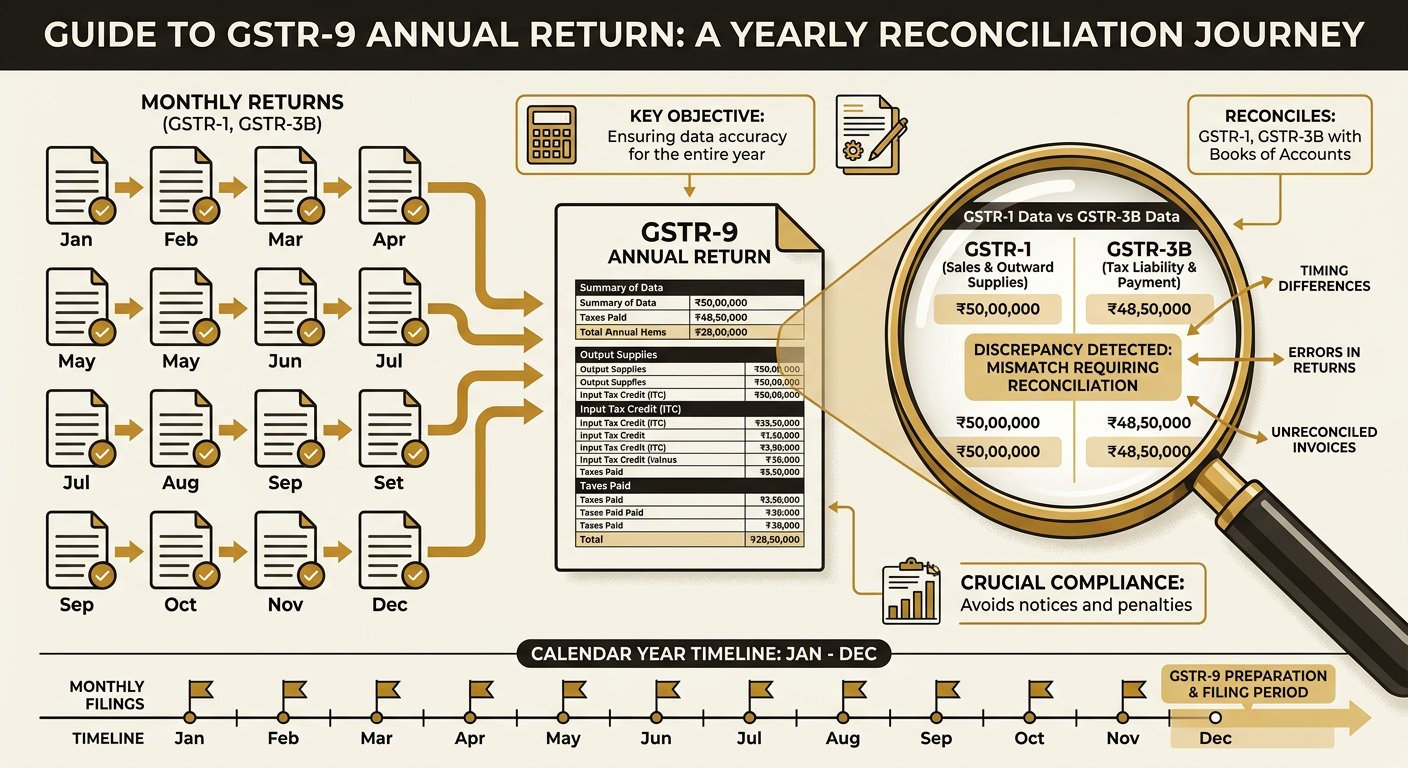
I file 100+ GSTR-9 annual returns every year. Most Delhi businesses treat it as a formality, but mismatches between GSTR-1 and GSTR-3B data show up here and trigger scrutiny. GSTR-9 is the annual return under GST -- a consolidation of all monthly/quarterly returns filed during the financial year.
Official Reference: Section 44 of the CGST Act 2017 mandates filing of GSTR-9 by 31st December of the year following the financial year. Rule 80 of CGST Rules provides the form details. GSTR-9C (reconciliation statement) is required for turnover above ₹5 crore.
Think of GSTR-9 as your GST "annual health checkup." It reconciles your entire year's data -- what you reported in GSTR-1, what you paid in GSTR-3B, and whether there are any gaps.
📍 Real Example -- Annual Reconciliation -- Janakpuri Distributor
A Janakpuri-based distributor with ₹8 crore turnover found ₹4.5 lakh mismatch between GSTR-1 total (₹8.12 crore) and GSTR-3B total (₹8.075 crore) during GSTR-9 preparation. The difference: 3 invoices reported in GSTR-1 of March but missed in GSTR-3B. We paid the short tax with interest in GSTR-9 before the audit could catch it.
Who Must File GSTR-9?
- Mandatory: All regular taxpayers with turnover above ₹2 crore in the financial year
- Exempt: Composition scheme taxpayers, Input Service Distributors, casual taxable persons
- GSTR-9C: Mandatory for turnover above ₹5 crore -- requires reconciliation statement certified by CA/CMA
⚠️ Common Mistake: Even if your turnover is below ₹2 crore, filing GSTR-9 is advisable. Non-filing creates a permanent gap in your compliance history. Many of my Delhi clients file voluntarily because it strengthens their compliance record for bank loans and government tenders.
How to Prepare for GSTR-9
- Download GSTR-1 and GSTR-3B data for all months of the financial year
- Reconcile monthly figures -- total outward supplies in GSTR-1 vs GSTR-3B
- Reconcile ITC -- ITC claimed in GSTR-3B vs GSTR-2A
- Identify gaps -- any invoice reported in GSTR-1 but not in GSTR-3B or vice versa
- Prepare adjustments -- for any corrections needed
- File before 31st December of the next financial year
Key Tables in GSTR-9
| Table | Details |
|---|---|
| 4 | Summary of outward supplies (auto-populated from GSTR-1) |
| 5 | Summary of inward supplies (auto-populated from GSTR-3B) |
| 6 | Tax paid -- details of tax paid as declared in GSTR-3B |
| 7 | ITC reversed -- details of ITC reversed during the year |
| 8 | Other ITC -- ITC not claimed in GSTR-3B but eligible |
| 9 | Tax already paid -- tax paid through GSTR-3B |
| 10-11 | Demands and refunds during the year |
| 12-13 | HSN-wise summary and rate-wise supplies |
Reconciliation Tips from My Practice
- GSTR-1 vs GSTR-3B: Total outward supply must match. Any gap means either GSTR-1 was under-reported or GSTR-3B was over-reported
- ITC claimed vs GSTR-2A: Excess ITC claimed is the #1 audit trigger
- HSN summary: Verify HSN codes match across all returns
- Turnover reconciliation: GST turnover should reconcile with books of accounts
💡 Pro Tip from Parul: Start GSTR-9 preparation in October, not December. Reconciliation takes time, especially for businesses with 500+ monthly invoices. I begin my clients' reconciliation in October so any gaps can be fixed before the December deadline.
📍 Real Example -- ITC Gap -- Maya Puri Industrial Client
A Maya Puri-based manufacturer claimed ₹42 lakh ITC in GSTR-3B but GSTR-2A showed only ₹38 lakh. The ₹4 lakh gap was from 3 suppliers who had filed late. During GSTR-9, we identified the exact invoices, communicated with suppliers, and reversed ₹1.2 lakh of permanently unmatched ITC. Better to reverse voluntarily than face a demand notice with penalty.
Common GSTR-9 Mistakes
- Not reconciling GSTR-1 with GSTR-3B -- leads to mismatch in Table 4 vs Table 5
- Claiming additional ITC in GSTR-9 -- ITC not claimed in GSTR-3B can only be claimed up to September return of next year
- Wrong HSN summary -- Table 17 requires HSN-wise details; verify with your purchase/sales registers
- Not reporting ITC reversals -- Rule 42/43 reversals must be reported
💡 Pro Tip from Parul: I prepare and file 100+ GSTR-9 annual returns every year. My process includes full reconciliation, gap analysis, and voluntary corrections -- all starting at ₹4,999. Call/WhatsApp: +91 95401 04776
Advertisement
Frequently Asked Questions
Is GSTR-9 mandatory for all GST registrants?
GSTR-9 is mandatory for regular taxpayers with turnover above ₹2 crore. Below ₹2 crore, filing is optional but recommended. Composition taxpayers file GSTR-9A instead.
What is the penalty for not filing GSTR-9?
Late fee of ₹200/day (₹100 CGST + ₹100 SGST), capped at 0.25% of turnover. For a ₹5 crore business, the maximum late fee would be ₹1.25 lakh -- significant enough to take the deadline seriously.
Can I pay additional tax through GSTR-9?
Yes, if you discover any short payment during reconciliation, you can pay the additional tax through DRC-03 and report it in GSTR-9. However, interest under Section 50 will apply from the original due date.
Advertisement